

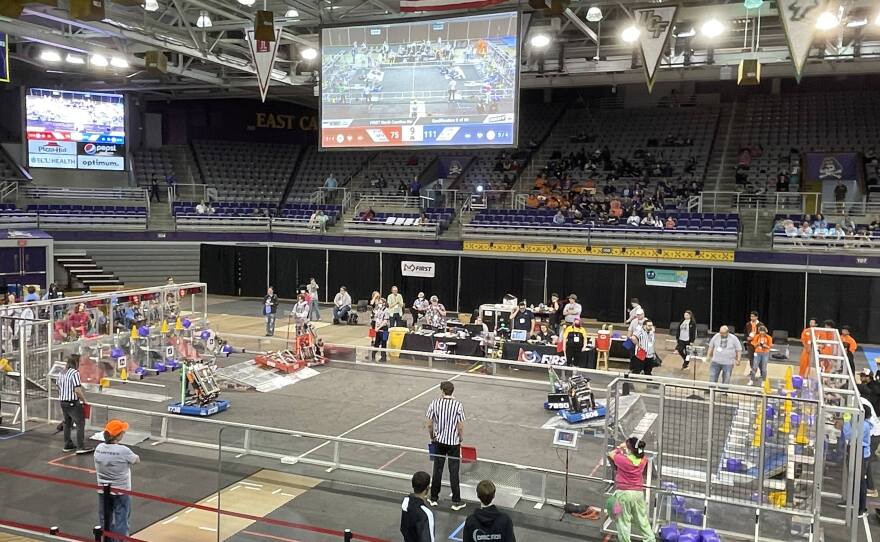
The Pitt County Pirates entered the FIRST state robotics competition at Minges Coliseum at ECU ranked 11th and with the goal of earning one of the 14 spots to go to nationals.
For the competition, teams build robots to compete in a game that changes each year. This year, the game involves three things. First, collecting cones and cubes and placing them on 3 different shelves. Each placement scores points, and completed rows score more. Second, on each side of the court are metal platforms that are like teeter totters. If you open or end a round balanced on the platform, you score points. And lastly, the first 30 seconds of each round are fully automated, meaning teams must program their robots to move independently. Most teams try to balance their robots on the platform for quick points, but others try a more daring, higher-scoring tactic of collecting and placing cubes.
Over two days of gameplay, each of the 40 teams compete in 12 matches — round robin style. From there, they're ranked and play in a double-elimination tournament. Importantly, they compete in groups of three, known as alliances. They're randomly assigned their partners and a color, red or blue.
It's Pitt’s third competition of the season. Their first at UNC Asheville was a learning moment for the team. Wyatt Trip is a mentor for the Pirates. He was on the team in high school and advises the engineers.
“We didn't start out that great with our first competition. We didn't have much time to practice," he said. "They had no idea really what was going on with the robot, but after Asheville, we really came back and were able to really figure everything out.”
Pitt placed 14th out of 29 at Asheville, but they took that loss and learned from it. A week later, they won the tournament at UNC-Pembroke.
Going into the state championships, they started off strong, winning their first qualification match handily as part of the blue alliance.
The second round, Pitt’s in the Red Alliance, with teams from Smithfield-Selma High School and Spring Lake.
In the automation phase, Pitt’s robot went for the more ambitious strategy — collecting and scoring two cubes. Its first attempt failed, but the second was successful.
The 30-second bell rang, and the robots were released to their drivers’ control. Two drivers control each robot, one drives it around while the other operates the arm. Pitt went for a cone, racing to place it on a peg, but dropped it. The pneumatics, or the system controlling arm’s clamping function, gave out, but it could still collect cubes, which are sucked in and tossed out by rollers.
Pitt grabbed a cube and raced with its arm extended to place it on a shelf, but it rounded a corner too quickly, teetering on its right side. The drivers quickly retracted the arm, recentering the robot’s gravity. Pitt continued collecting cubes, but the Red Alliance was falling behind. With just 30 seconds left, they attempted to balance all three of their robots on the platform at the same time. Each robot would score 10 points, and most teams opt for just one or two, but their Red Alliance was grasping for any way to pull ahead. All three robots successfully balanced on the platform — a rare feat. But it was not enough to overtake the Blue Alliance, who balanced 2 robots.
The Pitt Pirates grabbed their robot and wheeled it off to the Pit room, where each team has a tent set up to work on their robots. I joined them as they performed routine maintenance and fixed the pneumatics.
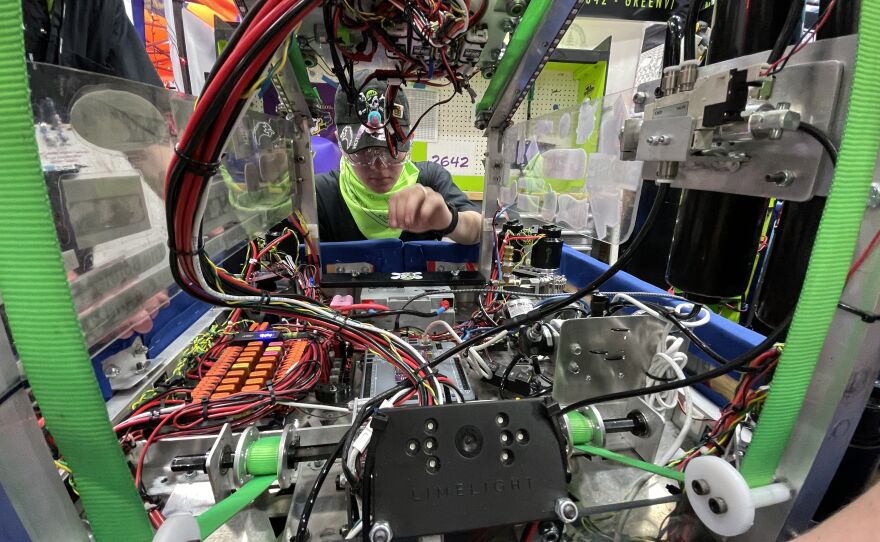
Their robot stands tall, at about 5 feet with an extendable arm at the top. The arm can go up and down as well as extend and retract. It's a unique design. Rather than one mechanism to collect both cones and cubes, they have two different ones that fit each of the objects better. The two-pronged claw can grip cones tightly, while rollers are used to trap and dispense cubes.
Thomas Drake is a senior on the team. He's first-mate, meaning he's second in command, and leads the programmers. Drake works in the pit during competitions. During the offseason, he and a few others worked on developing "swerve" — a new way to drive the robot.
“Swerve, it lets you move faster and in any direction you want," Drake said. "With a typical drive, you can move forward, backward or turn, but with swerve you can move in any direction while turning. It's way more movement you can do.”
It’s the first year they’ve successfully implemented swerve and it took all summer to figure it out. Each year has a new game and a new robot. The game is released in January, so teams have just two months to design and build a robot before the first competition. That means late nights and weekends — on top of homework.
Rylan Tuten is a junior and one of the team’s drivers.
“My job is to move the robot around the field in the most optimized and quickest way possible," he said.
To help with that, the team programmed a camera to assist lining the robot up with the object. It frees Tuten up to think more about getting around the field and scoring as much as possible.
Meanwhile, the team is feverishly working on the robot, trying to repair its pneumatics system. The hose delivering pressurized air kinked, rendering the claw inoperable. The students are the only ones in the tent. They work independently of professionals or their mentors. It's entirely their own project.
Evan Burke is one of the students working to repair the pneumatics system.
“Right now is basic maintenance. We’re tightening things, making sure they’re not going to fall off,” Burke said.
He mostly does quick fixes to help maintain the robot. It's Burke's first year in the program. He, as well as every other team member, is wearing black jumpsuits – like a NASCAR pit crew. Burke's jumpsuit is adorned with about 40 different buttons, designed by the team’s marketing section.
“We wear jumpsuits just to keep our clothes clean and nice pit pirate shirts clean. And I’ve been collecting team buttons and I like to show them off,” Burke said.
That the other side of this competition. While many work to design and build a robot, others take up the business side of things. They creating marketing materials and pitch to local businesses. With the help of the marketing team, they're able to cover registration fees and travel costs.
Going into the next match the Pitt Pirates are part of the Blue Alliance. Their competition, the Red Alliance, includes two highly ranked teams.
At the sound of the opening bell, the Pitt Pirates opt for a different automation phase. They go for a cube and drop it successfully, and then go for a balance, which is also successful. The 30-second bell rings and the robot's scatter. Pitt takes the role of scorer, grabbing cones and cubes and filling up their alliance’s shelves, while the others block and occasionally grab cubes, but they’re falling behind. With just 30 seconds in the match, Pitt continues trying to score points by grabbing a cone, leaving the others to balance on the beam. They do not end up balancing successfully, but Pitt does manage to score one more cone.
“Last round, we knew it was going to be tough, and we did well in that match," Burke said. "I’m very proud of how high we scored, especially up against a very tough team.”
Despite, those two losses, Pitt won eight out of 12 of the qualifying rounds, securing the 4th place seed in Sunday’s tournament. With teams from Greensboro and Charlotte in their alliance, they made it to the championship game, but lost to teams an alliance with teams from Chapel Hill, Smithfield-Selma and another school in Charlotte. The Pitt Pirates Robotics Team earned a spot at nationals and will compete in Houston from April 19 to the 23rd.
