

By the time David Batts spoke in front of the Edgecombe County Board of Commissioners, they had already changed its zoning ordinance to allow data centers and cryptomining facilities to be built in the Kingsboro Industrial Park.
The next decision was whether the county should sell 120 acres it owns to developer Energy Storage Solutions for a proposed data center.
Batts, 69, lives about a mile from the county owned development site. A week before that December 1 meeting, he'd attended a community meeting about the data center proposed for the industrial park and was unsatisfied with what he'd heard.
When his name was called, Batts stood up from his chair – the closest in the auditorium to the podium.
With his Army Veteran hat perched atop his head, Batts relayed the concerns he and other residents harbor about a proposal that developer Energy Storage Solutions has claimed could see up to 300 acres developed, costing as much as $19.2 billion.
Batts talked about how the jobs touted for the facility would likely be temporary and wouldn't go to locals. He expressed reservations about noise levels from the facility. And he ended on a point intended for the elected officials on the dais facing him.
"We will primary you. And we will try to get people that really stand up for the community of Kingsboro," Batts said.
What Batts didn't immediately say was that he would be the person seeking election, running against four-term incumbent Donald Boswell in March's Democratic primary election for Edgecombe County's sixth district seat that encompasses Kingsboro.

Batts' promise, and his willingness to follow through on it, are emblematic of how the public's mistrust toward data centers is becoming a political flashpoint across North Carolina. Elected officials who support data center projects – or who voters perceive as failing to oppose them staunchly enough – are facing challenges like the one Batts mounted.
Batts' campaign signs made his platform clear, stating "Vote no for data centers."
Boswell did not respond to an NC Newsroom email seeking comment for this story, and attempts to reach him at the phone number listed on the Edgecombe County Commissioners page were unsuccessful.
But Boswell told the Rocky Mount Telegram before the election that he wouldn't take a stance on the data center proposal because he hadn't seen financial information from Energy Storage Solutions.
On data centers more broadly, Boswell told the Telegram, "I can't find anything wrong with them — and I've done all the research I can."
Democratic voters in the southern Edgecombe County district agreed with Batts, not Boswell. In the March 3 primary, Batts received 337 votes compared to Boswell's 162.
"The people saw what I was about, and they saw that I was against data centers. That's the reason I think they voted me in: Because I stood for something," Batts said in a post-election interview.
'Upset about data centers'
The data center debate is playing out in front of county boards and in city halls across North Carolina, almost always with opposition from local residents who want no part of a data center in their community.
In Stokes County, the board narrowly approved a planned $10 billion project despite significant opposition from residents who decried the facility's potential impact on rural Walnut Cove. Community members and environmental groups are suing the county, alleging commissioners improperly approved the project.
And in the southwestern Wake County's Apex, a developer pulled a planned data center after residents pushed back. That same developer, Michael Natelli, is now involved in an attempt to rezone 40 acres in Vance County for an industrial park, raising concerns among residents there that a data center could be planned for that parcel.
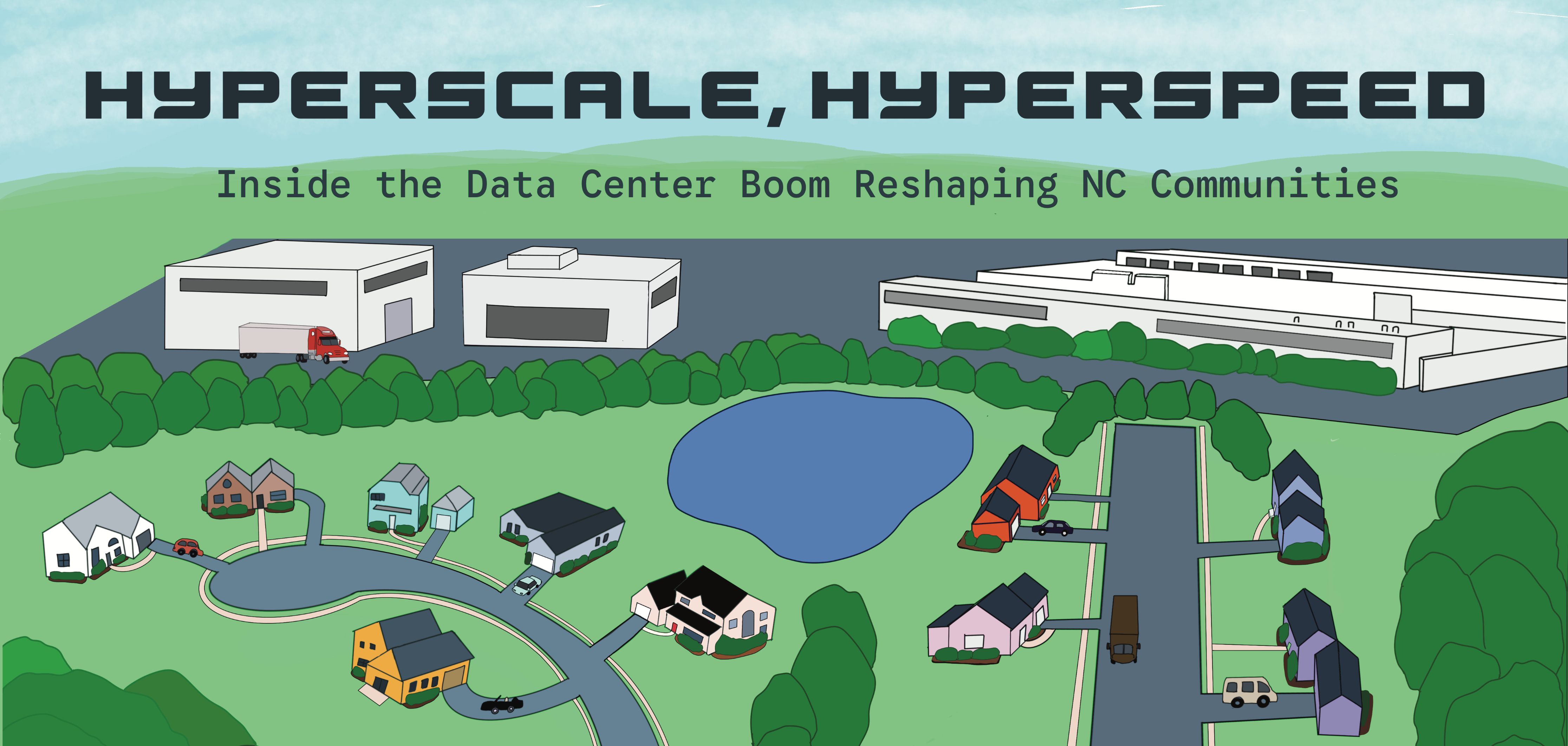
In this 6-part series, BPR, the NC Newsroom, WFAE, and WUNC explore North Carolina's accelerating data-center boom and its real impact on local communities.
Through on-the-ground reporting, document reviews, and conversations with residents, the series examines how Big Tech is reshaping small towns, consuming vast amounts of power, and striking deals that aren't always clear. It explores who benefits, who bears the cost, and why North Carolina has become an appealing target for server farms despite modest public scrutiny. By following the money, the energy demands, and the promises made to communities, the project aims to reveal what's at stake as the cloud moves into the state’s backroads.
Recent polling from Elon University shows that opposition to data centers is the leading stance for wide swaths of North Carolinians across age, gender, education and income levels.
Of 800 people polled, 24% said they would support a data center in their community, 44% said they would oppose it and 32% said they were unsure.
The sole group identified that supports data centers, albeit narrowly, is Republicans. Of those polled, 36% supported data centers while 35% opposed them. That compares to 55% of Democrats who oppose data centers and 48% of independent voters.
The North Carolina Environmental Justice Network is working with people opposed to data centers across the state, including bringing local groups together to discuss what is working and what isn't.
"This is across economic lines, it's across racial lines, it's across county lines. Everyone that I have talked to is upset about data centers," N.C. Environmental Justice Network co-director Rania Masri said in an interview.

Masri pointed to concerns about data centers' potential impact on utility bills, their water usage, the potential for air pollution from on-site power generation and noise levels from cooling fans.
People are also alarmed, she said, about transforming large tracts of land from rural to industrial uses without significant numbers of permanent jobs at the facilities. To that end, the ice breaker question at an early March convening of anti-data center organizers from across the state was what they would do with 1,800 acres – the land covered by the Stokes County proposal – instead of building a data center.
Industry viewpoint
Officials from trade group the Data Center Coalition argue that many of those concerns are overblown, pointing to research from the Lawrence Berkeley National Lab that indicates data centers can actually lower electricity costs because the costs of upgrades are spread over more electricity sold and Virginia data showing that most data centers use less water than a large commercial office building.
Dan Diorio, the coalition's vice president of state policy, believes part of the data center pushback comes from conflating the projects with concerns about artificial intelligence.
Most data centers being built, Diorio said, support cloud software that underpins key parts of modern life such as email or streaming.
"(AI) is an important growth driver and data centers enable it to be deployed at scale, but it is not the be-all, end-all of data centers and I think the inherent distrust of AI drives that inherent distrust of data center infrastructure and the role that it plays in our everyday lives," Diorio said.
Kingsboro's history
On a recent sunny afternoon, Batts pulled his pickup truck onto Kingsboro Road, turned right and drove about a mile.
He passed a roadside marker honoring the last time Kingsboro residents banded together to stave off a project they thought was harmful for their community. Someone had propped a black sign reading "No data center" near its base.

The earlier effort revolved around a slaughterhouse proposal from meat company Iowa Beef Processors, beginning in 1995 and lasting into 1996. The plant would have run nonstop, killing between 20,000 and 30,000 hogs each day and using 6 million gallons of water daily.
A group of Kingsboro residents and concerned people from neighboring communities banded together to form the group Citizens for Responsible Zoning and, eventually, the Kingsboro Property Owners Association.
In April 1996, county commissioners voted the slaughterhouse's zoning request down.
Batts says the aims of the Kingsboro group then and the modern anti-data center group are similar in that both are helping people understand the impacts proposed projects could have.
But changes in technology over the last 30 years means how today's Edgecombe Neighbors for Data Center Accountability organization spreads its information looks very different.
"We can get to more people. Back in '95 it was hands on, you know, door to door, just talking to people, gathering community, galvanizing. That's the way it was then. But now you can go on your phone, you can mass text, you can reach groups in other towns," Batts said.
After the slaughterhouse effort failed, QVC moved onto the site with its massive distribution center.
Passing a 1.2-million gallon water tank with Kingsboro painted on its side and an electric substation, Batts hung a left onto QVC Boulevard. The infrastructure there was meant to spur job creation in Edgecombe County, one of the state's poorest.
The Kingsboro industrial park's recent history is complicated. A Triangle Tire factory announced in 2017 for a 400-acre tract in the park was delayed amid trade disputes with China and eventually canceled.
And a sodium ion battery plant that had been announced in 2024 as a $1.4-billion investment that would bring 1,000 jobs to Kingsboro failed by last September when the company, Natron, failed as the price of lithium batteries fell and investors grew hesitant to fund batteries more broadly.
Batts viewed both of those projects as significantly more beneficial for the residents of Kingsboro than the proposed data center.
"The battery plant and the tire plant would have been great compared to this data center," Batts said, expressing significant skepticism about the projected employment numbers touted by data center developers.
Batts turned left onto QVC Boulevard.
For a time, the shopping giant employed about 2,000 people at a massive distribution center here, but it burned down in 2021, a fire Batts called "catastrophic" for the area.
Batts drove until the pavement ended. Then he kept going.
As his pickup truck jolted along a dirt road cut between a treeline and some railroad tracks, Batts noted the now-rebuilt warehouse that had been QVC. Just past it, he pointed to the 120 acres that county officials have said Energy Storage Solutions wants to build on.
"Data centers are unforgiving. They don't give back. They just take, take, take," Batts said.

Recalling his conversations with voters on election day, Batts said he mainly heard concerns about unanswered questions raised by the Kingsboro data center proposal. Many of those questions have been lingering for several months.
"The majority of people just want peace of mind. They don't want to be worried and think about what data centers can do," Batts said.
Pausing data center development
North Carolina officials who are unsure about data centers are using moratoriums to buy at least some time, or at least to give themselves a chance to craft rules around their development.
From the northeastern part of the state to the far western reaches, about a dozen places have either passed one-year moratoriums on data centers or are poised to do so.
Gates County was one of the earliest to do so, passing its resolution in December 2025.
Emily Truman, the chairwoman of the county's board, said commissioners began considering a moratorium after the county's planning director heard that data center developers were exploring the possibility of projects in the state's northeastern corner.
Gates County officials have questions about what a data center would mean for the county's resources, including a water system that has been under a moratorium since 2018.
"If it's going to put a strain on our water system, if it's going to put a strain on our power grid, if it's going to be something that our citizens are outright not in alignment with, then it's not going to hit the values of our county," Truman said.
So far, Truman said every constituent she's spoken with has been opposed to data centers.
Asked whether one year is a long enough time to decide how to permanently address an issue that seems to have so many sweeping questions, Truman notes that a moratorium can always be renewed if commissioners still don't have the answers they need.
"I think one year is a great length for something of this scale to begin to have the information that we need to make a decision more long-term," Truman said.
'Catching a fire'
Unless someone mounts a write-in campaign, Batts will be the next Edgecombe County commissioner for District 6.
But until then, Batts plans to closely track data center developments, attending county commission meetings as well as meetings of a data center advisory board county officials have created.
At least one member of Edgecombe Neighbors for Data Center Accountability speaks at each county commission meeting, whether there is a data center item on the agenda or not.
The group is trying to gather 1,000 signatures for a petition urging commissioners not to sell the industrial park land to Energy Storage Solutions.
The developer hasn't sent county officials a formal proposal for the Kingsboro land or provided financial information proving it can complete the data center.
Batts is hopeful that Kingsboro residents can once again find the right message or piece of information to halt a controversial project.
"It's catching a fire, and the more (people) hear about it, the more they want to know and, it seems to me, the more they have a bad taste for it," Batts said.
