

Jacki Lyden
Longtime listeners recognize Jacki Lyden's voice from her frequent work as a substitute host on NPR. As a journalist who has been with NPR since 1979, Lyden regards herself first and foremost as a storyteller and looks for the distinctive human voice in a huge range of national and international stories.
In the last five years, Lyden has reported from diverse locations including Paris, New York, the backstreets of Baghdad, the byways around rural Kentucky and spent time among former prostitutes in Nashville.
Most recently, Lyden focused her reporting on the underground, literally. In partnership with National Geographic, she and photographer Stephen Alvarez explored the catacombs and underground of the City of Light. The report of the expedition aired on Weekend Edition Sunday and was the cover story of the February 2011 National Geographic magazine.
Lyden's book, Daughter of the Queen of Sheba, recounts her own experience growing up under the spell of a colorful mother suffering from manic depression. The memoir has been published in 11 foreign editions and is considered a memoir classic by The New York Times. Daughter of the Queen of Sheba has been in process as a film, based upon a script by the A-list writer, Karen Croner. She is working on a sequel to the book which will be about memory and what one can really hold on to in a tumultuous life.
Along with Scott Simon, current host of Weekend Edition Saturday, and producer Jonathan Baer, Lyden helped to pioneer NPR's Chicago bureau in 1979. Ten years later, Lyden became NPR's London correspondent and reported on the IRA in Northern Ireland.
In the summer of 1990, when Saddam Hussein invaded Kuwait, Lyden went to Amman, Jordan, where she covered the Gulf War often traveling to and reporting from Baghdad and many other Middle Eastern cites. Her work supported NPR's 1991 Alfred I. duPont-Columbia University Award for Gulf War coverage. Additionally, Lyden has reported from countries such as Syria, Lebanon, Iraq, Jordan, Egypt and Iran. In 1995, she did a groundbreaking series for NPR on Iran on the emerging civil society and dissent, called "Iran at the Crossroads."
At home in Brooklyn on September 11, 2001, Lyden was NPR's first reporter on the air from New York that day. She shared in NPR's George Foster Peabody Award and Alfred I. duPont-Columbia University Award for coverage of the 9/11 terrorist attacks. Lyden later covered the aftermath of the fall of the Taliban in Afghanistan.
In 2002, Lyden and producer Davar Ardalan received the Gracie Award from American Women in Radio and Television for best foreign documentary for "Loss and Its Aftermath." The film was about bereavement among Palestinians and Jews in Gaza, the West Bank and Israel.
That same year Lyden hosted the "National Story Project" on Weekend All Things Considered with internationally-acclaimed novelist Paul Auster. The book that emerged from the show, I Thought My Father Was God, became a national bestseller.
Over the years, Lyden's articles have been publications such as Granta, Atlantic Monthly, The New York Times and The Washington Post. She is a popular speaker, especially on mental health.
A graduate of Valparaiso University, Lyden was given an honorary Ph.D. from the school in 2010. She participated in Valparaiso's program of study at Cambridge University and was a 1991-92 Benton Fellow in Middle East studies at the University of Chicago.
-
 Paul Auster was many things: novelist, screenwriter, poet, and NPR contributor. He died this week from cancer at the age of 77. Former NPR host Jacki Lyden has a remembrance.
 -
 The actress seemed game for anything: She played a heartbroken lover in The Last Picture Show, a creepy housekeeper in Young Frankenstein and even competed on Dancing With the Stars.
 -
 The Oscar-winning film star with the distinctive Scottish brogue eventually outgrew the 007 role to appear in a range of movies in a career that spanned nearly a half-century.
 -
 A Wisconsin church built entirely by hand from the forests around it has been operating continuously since 1853. St. John Chrysostom is an example of the "carpenter Gothic" style.
 -
One in five Americans have some experience with mental illness every year — and these three new memoirs dig into that experience, whether it's the author's own illness or that of a loved one.
-
 Vanderbilt, the mother of CNN journalist Anderson Cooper, was known for vivid paintings and collages, and for designing glamorous jeans.
 -
The fabulously louche social scene of the mid-century French Riviera — where socialites and stars mixed with the likes of Winston Churchill — comes alive again in Mary S. Lovell's The Riviera Set.
-
British actor Sir Roger Moore began his career as a model and small-time MGM studio player but was best known for stepping into the role of James Bond in the 1970s and 1980s.
-
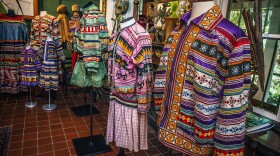 Native American symbols have long caught the eye of non-Native fashion designers. But when it comes to Seminole patchwork designs, where is the line between inspiration and appropriation?
 -
Italian fashion brand Moschino is causing controversy with its pill-themed 2017 collection. Randy Anderson of Eden House Recovery Services is pushing stores not to sell the clothing.


